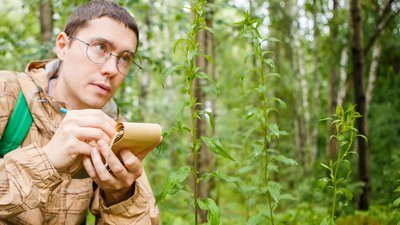
Online Bachelor of Science in Coastal Environmental Science from LSU

Study coastal ecosystems, environmental science, and marine systems.
Build analytical, scientific, and systems-thinking skills.
Prepare for careers in environmental consulting, compliance, and research.
This program is designed for students pursuing graduate or professional degrees.


Save Time. Save Money. Simplify Your Application.
LSU Online now offers a FREE transcript service that helps you collect your transcripts at no cost—so you can focus on your future! Learn More
Admissions
Whether you're a first-time freshman or a transfer student, our admissions team is here to support you from day one.

Apply by
Dec 14, 2026

Classes begin
Jan 11, 2027
I have no college credits
First Time Freshman
- 3.0 Core GPA on the 19 units of college-preparatory high school courses as outlined in the LSU Core
- LSU is a test-optional institution which means applicants will have the choice to select if they wish to have their ACT or SAT scores considered for admission. Click here to learn more!
I have some college credits
Transfer Student General Admission Requirements
- 30* or more transferable (academic, non-remedial) credit hours from a regionally-accredited college or university
- 2.5 academic GPA on all transferable college work attempted
- A grade of “C” or better in a college-level English course that fulfilled a general education requirement at the institution where it was taken
- A grade of “C” or better in a college-level Math course that fulfilled a general education requirement at the institution where it was taken
*Students who will not have 30 transferable credit hours by the time they plan to enroll at LSU can still be considered for admission if they meet all remaining transfer requirements.
To see about transfer credits please check out the TIGER TRANSFER TABLES.
Re-Entry Student Admission Requirements
- Students interested in applying for re-entry to LSU must have a 2.0 GPA on all LSU coursework and must meet the requirements for their prospective senior college.
- Students who have attempted 30 or more hours at another institution must also have a 2.5 cumulative GPA on all college work attempted. For your senior college specific requirements please check out the Re-Entry Student Requirements per College.
If you feel like you do not meet any of the above qualifications please reach out to your Enrollment Coach team member as there are different evaluation pathways for non-traditional students to take.
Undergraduate students who are reviewed and admitted by meeting LSU A&M general admissions requirements but do not meet the admittance requirements to a senior college have two admissions options:
- Option 1
Students can start with The University College Center for Freshman Year (UCFY). This academic unit is designed for new freshmen and some transfer and re-entry students. Their mission is to prepare incoming students for success at LSU and to help define their academic and career goals. Students typically exit the UCFY at the conclusion of the freshman year and enter one of the degree-granting senior colleges at LSU. - Option 2
Students can start with The Center for Advising and Counseling (UCAC). This administrative unit serves as the academic home for students who have attempted 30-plus hours of college credit and who do not yet meet the admission requirements for one of the University’s degree-granting senior colleges.
For a list of specific senior college requirements please visit the LSU A&M Undergraduate Admission page.
Start Dates
This program offers three start dates each year: Fall 1, Spring 1, and Summer 1.
Tuition
- 120 credit hours
- Total credit hours per program
- $465
- Cost per credit hour
- $13,950
- Total cost with fees and maximum transfer credits
- $55,800
- Total cost with fees
LSU's online programs offer competitive, flat-rate tuition with no out-of-state fees. Plus, you may be able to save even more by transferring up to 75% of previous credits.
Tuition & Fees
*For further information about the approval for transfer credits and other requirements, please visit this site.
The total cost above does not include transfer credit or financial aid. Cost per credit hour and fees are subject to change. Fee schedules may vary by program depending on course-specific fees for proctoring and/or books. Please contact a Student Success Coach for more information.
Financial Aid Available
LSU offers several ways to help you pay for your degree including credit for prior learning (PLA), financial aid, and veteran education benefits. Learn More.
Academics
Develop a strong foundation in coastal environmental science through coursework designed to strengthen scientific analysis, environmental problem-solving, and data-driven decision-making skills applicable across environmental, regulatory, and coastal management fields.
Courses
| General Education | Credit Hours |
|---|---|
ENGL 1001 English Composition |
3 |
ENGL 2000 English Composition |
3 |
General Education Arts |
3 |
General Education Analytical Reasoning 1: MATH 1530 Differential Calculus |
3 |
General Education Analytical Reasoning 2: MATH 1540 Integral Calculus |
3 |
General Education Humanities I |
3 |
General Education Humanities II |
3 |
General Education Humanities III |
3 |
General Education Social Sciences I |
3 |
General Education Social Sciences II [2000-Level] |
3 |
General Education Life Science: BIOL 1201 Biology for Science Majors I |
3 |
General Education Life Science: BIOL 1202 Biology for Science Majors II |
3 |
General Education Physical Science: PHYS 2001 General Physics I |
3 |
Total Credit Hours |
39 |
| Core Requirements | Credit Hours |
|---|---|
EXST 2201 Introduction to Statistical Analysis |
4 |
BIOL 1212 Biology Laboratory for Science Majors II |
2 |
CHEM 1201 General Chemistry I |
3 |
CHEM 1202 General Chemistry II |
3 |
ENVS 1126 Introduction to Environmental Sciences |
3 |
ENVS 1010 Introduction to Coastal Environmental Science |
1 |
CHEM 1212 General Chemistry Laboratory |
2 |
CHEM 2261 Organic Chemistry I |
3 |
OCS 2007 Introduction to Marine Sciences: Geological and Physical |
3 |
CHEM 2001 Analytical Chemistry |
3 |
CHEM 2002 Analytical Chemistry Laboratory |
1 |
OCS 2011 Introduction to MATLAB for Coastal Sciences |
3 |
OCS 2008 Introduction to Marine Sciences: Life Processes |
3 |
GEOG 2200 Hazards, Disasters and the Environment |
3 |
PHYS 2108 Introductory Physics Laboratory |
1 |
PHYS 2002 General Physics II |
3 |
PHYS 2109 General Physics Laboratory |
1 |
MATH 1552 Analytic Geometry and Calculus II |
4 |
OCS 2015 Laboratory Methods in Oceanography & Coastal Sciences |
2 |
OCS 3103 Global Environmental Cycles |
3 |
ENVS 3102 Mathematical Methods in Science |
3 |
ENVS 4149 Design of Environmental Management Systems |
3 |
ENVS 4999 Capstone in Coastal Environmental Science |
1 |
Total Credit Hours |
58 |
| Concentration | Total Credit Hours |
|---|---|
Approved Coastal Environmental Science Elective 1 (ENVS 4500) |
3 |
Approved Coastal Environmental Science Elective 2 (ENVS 4113) |
3 |
Approved Coastal Environmental Science Elective 3 (ENVS 4264) |
3 |
Approved Coastal Environmental Science Elective 4 (ENVS 4101) |
3 |
Approved Coastal Environmental Science Elective 5 (ENVS 4266) |
3 |
Total Credit Hours |
15 |
| General Electives | Credit Hours |
|---|---|
Approved Elective 1 |
|
Approved Elective 2 |
|
Approved Elective 3 |
|
Total Credit Hours |
8 |
| Total Credit Hours |
|---|
120 credit hours |
| Coastal Environmental Science Electives |
|---|
Approved coastal environmental science electives (15 hours required for the applied coastal environmental science area of concentration) are environmental courses numbered 3000 and higher and must include at least one course from each of the four areas of emphasis: |
Physical Science Area: |
ENVS 4113 Multi-Media Chemical Behavior for Risk Assessment |
ENVS 4145 Remote Sensing Fundamentals for Environmental Scientists |
Chemistry Area: |
ENVS 4101 Environmental Chemistry |
ENVS 4113 Multi-Media Chemical Behavior for Risk Assessment |
ENVS 4477 Environmental Toxicology: Introduction and Applications |
Biology Area: |
ENVS 4477 Environmental Toxicology: Introduction and Applications |
ENVS 4500 Health Effects of Environmental Pollutants |
Policy and Management Area: |
ENVS 4149 Design of Environmental Management Systems |
ENVS 4261 Energy and the Environment |
ENVS 4266 Ocean Policy |
ENVS 4264 Regulations of Environmental Hazards |
Applied Coastal Environmental Science Concentration
- Build a strong foundation in environmental science with a focus on real-world coastal applications through LSU’s online Bachelor of Science in Coastal Environmental Science.
- Comprehensive study of coastal systems, environmental processes, and marine science
- Coursework focused on environmental monitoring, data analysis, and regulatory compliance
- Emphasis on Louisiana’s coastal challenges, including wetland loss, water quality, and restoration efforts
- Graduates develop scientific, analytical, and communication skills that prepare them for careers in environmental consulting, regulatory agencies, and coastal management
Lab Residency Requirement
This program includes in-person lab components for Biology and Chemistry courses. Students may fulfill these requirements by attending a summer residency over two summers on the LSU campus or by completing equivalent lab courses at an accredited institution near them and transferring those credits. Course equivalencies can be verified using the LSU Tiger Transfer Tables.
Licensure & Certification
- Prepares students for the Ecological Society of America’s Certified Ecologist credential.
Career-Ready Skills
- Demonstrate knowledge of environmental science principles, including coastal systems, climate change, and human-environment interactions;
- Apply critical thinking and systems-based approaches to analyze complex environmental and regulatory challenges;
- Utilize scientific methods, data collection, and analysis tools to support environmental monitoring and decision-making;
- Communicate technical environmental information effectively through written, visual, and verbal formats.
Careers
Step into in-demand environmental careers with a Bachelor of Science in Coastal Environmental Science, designed to prepare you for roles in environmental science, regulatory compliance, and coastal management across public and private sectors.
The U.S. Bureau of Labor Statistics reports a median annual salary of $80,060 for environmental scientists and specialists, with steady job growth projected over the next decade.
Employment for occupational health and safety specialists is projected to grow 12.7% through 2036, faster than average, driven by increasing environmental and workplace safety regulations (Source: BLS).
Explore career paths and salaries in coastal environmental science:
Entry-Level Roles (0-2 years of experience)
Start building your career with roles that provide foundational experience in the industry.
| Role | Average Salary |
|---|---|
Environmental Science Technician |
$49,000 (BLS) |
Environmental Field Technician |
$49,000 (BLS) |
Laboratory Technician |
$49,000 (BLS) |
Mid-Level Roles (2-5 years of experience)
With experience and your degree, you can advance into more specialized and higher-paying roles.
| Role | Average Salary |
|---|---|
Environmental Scientist |
$80,000 (BLS) |
Occupational Health & Safety Specialist |
$78,000 (USA Wage) |
Compliance Officer |
$78,000 (BLS) |
Advanced Roles (5+ years of experience)
Experienced professionals often move into leadership or strategic roles.
| Role | Average Salary |
|---|---|
Natural Sciences Manager |
$100,000 (BLS) |
Environmental Program Manager |
$98,000 (ZipRecruiter) |
Senior Environmental Consultant |
$110,000 (ZipRecruiter) |